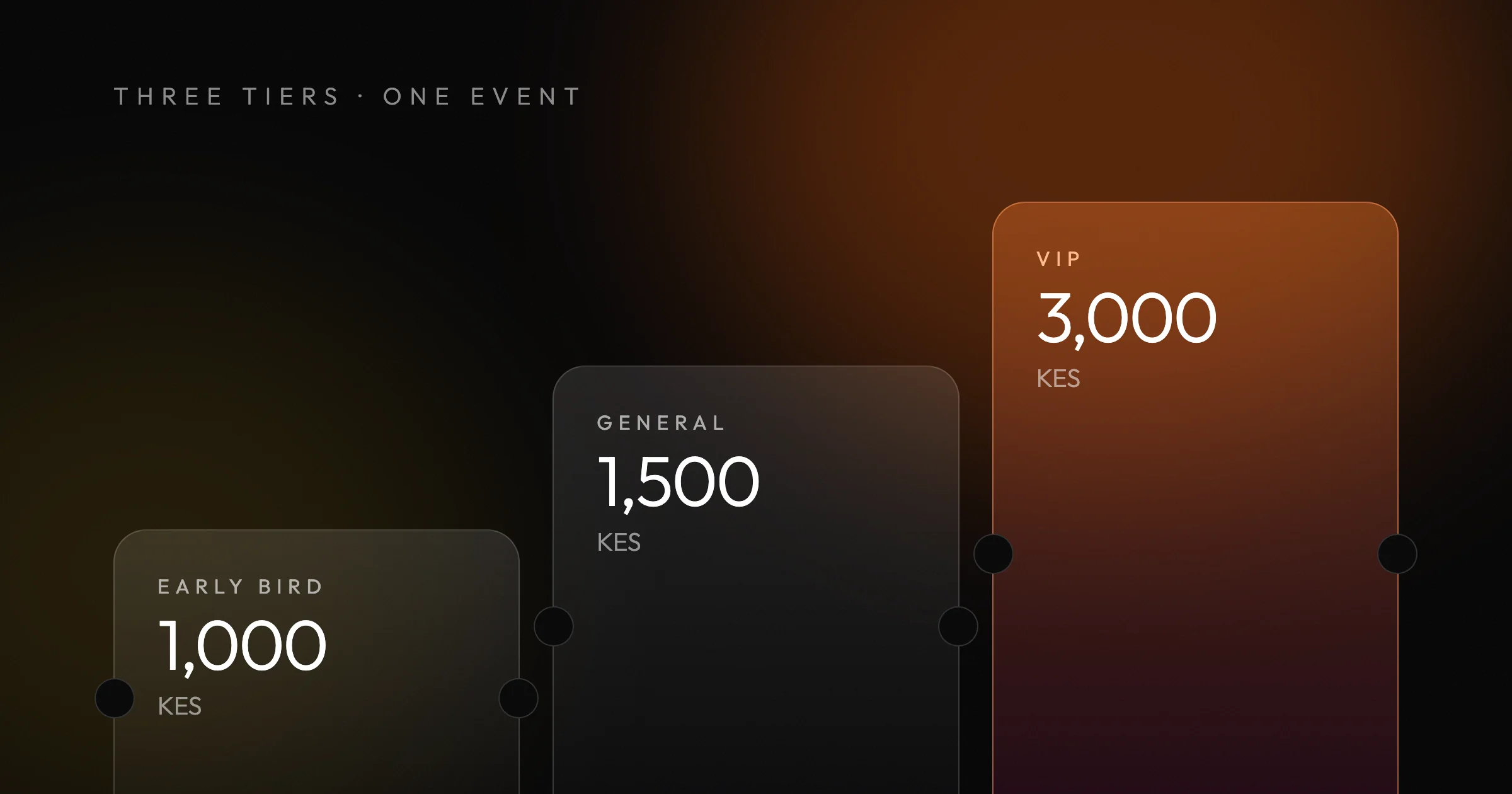
Pricing your first event can feel like guesswork. Price too high and the room stays half empty. Price too low and you sell out and still lose money. This guide walks you through the thinking, step by step, so your prices come from your numbers and not from what feels right on the day.
Most of it applies whichever platform you sell on. Where loopinone has a feature that helps, we point it out.
Start from your costs and your capacity
Before you pick a single price, write down two numbers: what the event will cost you, and how many people the space can hold.
Your costs are everything you pay whether you sell ten tickets or a thousand:
- Venue hire or deposit
- Sound, lighting and stage
- Staff, security and ushers
- Performers, DJs or speakers
- Decor, printing and marketing
Add them up. That total is the amount your ticket sales need to cover before you make anything.
Your capacity is the ceiling. If the venue holds 300 people, you can never sell 301 tickets, so there is no point planning as if you could. Divide your costs by your capacity and you get the lowest average price that breaks even if every ticket sells. Every ticket will not sell, so your real prices need to sit comfortably above that figure.
On loopinone you can set an overall capacity for the event, so you never sell more tickets than the venue can hold, even across several ticket types.
One price or several tiers
A single price is simple. Guests understand it straight away and there is nothing to explain. For a small event with one kind of guest, it is often the right choice.
Several tiers let you serve different people at different prices. A student and a corporate guest may both want to come, but they will not pay the same amount. Tiers also give you more control over when money comes in.
If you use tiers, give each one a clear job. Ask yourself what a ticket is for before you set its price:
- Is it there to get early sales moving?
- Is it the standard ticket most people buy?
- Is it a better experience for people willing to pay more?
- Is it for groups who come together?
If you cannot say what a tier is for, you probably do not need it. Three or four types is plenty for most events. Too many choices slow people down at checkout.
On loopinone a ticket is priced one of two ways: a fixed price, or pay-what-you-want. General, early bird, VIP and free are names and settings you give your tickets, not separate kinds. Free is simply a fixed ticket priced at zero. You can cap how many of each ticket sell, and limit how many one person can buy in a single order, up to 10.
Early bird: reward the people who commit first
Early bird tickets are cheaper tickets sold for a limited time or in a limited quantity. They do two things for you.
First, they bring in money early, when you have deposits to pay and no other income. Second, they tell you whether people are interested. If early birds sell slowly, you know to push your marketing harder well before the event.
A few rules keep early bird pricing working for you:
- Make the discount real but not so deep that you lose money on every sale.
- Set a firm end date or a firm number, and stick to it.
- Do not bring early bird back once it has ended. People who paid full price will notice.
On loopinone each ticket type has its own sale start and end dates, so an early bird ticket can close on a set date without you having to remember to switch it off.
VIP and group tickets
A VIP ticket should give guests something they can feel: a better view, a separate area, faster entry, a drink on arrival. If the only difference is the price, people will see through it. Price VIP from the cost of what you add plus a margin, and keep the numbers small so it stays special.
Group tickets suit events where people come with friends. Instead of selling five separate tickets, you sell one ticket that admits five people, usually at a slightly lower price per head. Groups bring more people through the door, and one person handles the payment for everyone.
On loopinone one ticket can admit several people, so a table for six or a group of four is a single ticket at checkout.
Free tickets
Free events still benefit from tickets. A ticket tells you how many people to expect, gives you a guest list, and lets you check people in at the door.
Free tickets can also sit alongside paid ones. You might offer free entry to volunteers or press, or a free general ticket with a paid VIP option. Free events cost nothing on loopinone.
Keep in mind that people sometimes treat a free ticket as a maybe. Expect some no-shows and plan staff and supplies with that in mind.
Pay what you want
With pay-what-you-want, the guest chooses how much to pay. It works well for community events, fundraisers and gatherings where you want nobody turned away, while still letting supporters give more.
The risk is that most people pay the least they can. You protect yourself in two ways:
- Set a minimum that covers your cost per guest, or close to it.
- Show a suggested price, so people know what a fair amount looks like.
On loopinone a pay-what-you-want ticket lets the guest pay any amount at or above the minimum you set, and you can add a suggested price. One thing to know: your event card shows "From" the lowest price. If a pay-what-you-want ticket has no minimum, your event will show as "Free", which may not be the message you want.
Who pays the fee, and what guests see
Every ticketing platform charges something. On loopinone there are two charges. Our commission is 5% of each paid ticket, and you always pay it; it is never added to what guests pay. The second is the payment charge for moving the money, passed on at cost. There is no setup fee and no subscription.
You choose who pays the payment charge:
- Guests pay it on top. The guest sees the payment charge added at checkout, so it does not come out of what you receive.
- You absorb it. The guest pays exactly the ticket price, and the payment charge comes out of what you receive.
Neither is wrong. Passing it on keeps your listed prices lower and your income predictable. Absorbing it makes the price the guest sees the price they pay, which some audiences prefer. If you absorb it, raise your ticket price slightly so your costs are still covered. The choice applies to orders made after you change it, so decide before sales open if you can.
Guests can pay with M-Pesa, Airtel Money or card, so you do not need to price around a single payment method.
Set your refund policy at the same time. On loopinone you can choose no refunds, refunds up to 1 day, 7 days or 30 days before the event, or a custom policy with a note. A clear policy helps people commit to buying early.
Change prices as sales come in
Your first prices are a starting point. Watch how each ticket type sells and adjust.
- If early birds vanish in a day, your general price can probably go up.
- If VIP is not moving, add something to it or lower the price.
- If one type sells out and another stalls, move capacity between them.
On loopinone you can change tickets as sales come in. If you run events regularly, you can also copy the tickets from one of your other events into a new event that has none yet, then adjust them. Sale dates are not copied, so set those again.
Put it together: a worked example
For example, say you are throwing a party. These are made-up round numbers to show the method.
Your costs:
- Venue: KES 100,000
- Sound and lighting: KES 50,000
- Staff and security: KES 30,000
- Marketing and decor: KES 20,000
Total costs: KES 200,000. The venue holds 300 people.
You set three tiers:
- Early bird: 100 tickets at KES 1,000
- General: 150 tickets at KES 1,500
- VIP: 50 tickets at KES 3,000
If every ticket sells, that is KES 475,000 in ticket sales. But you need to know the point where you stop losing money.
On each paid ticket loopinone takes 5%, so you keep 95% of the ticket price. Say you also absorb the payment charge: look it up and subtract it too.
Before the payment charge:
- 100 early birds at KES 1,000 bring in KES 100,000. You keep KES 95,000.
- You still need KES 105,000. Each general ticket leaves you KES 1,425.
- KES 105,000 divided by KES 1,425 is about 74 general tickets.
So you break even at roughly 174 tickets, plus a few more to cover the payment charge. If guests pay the payment charge on top instead, you skip that extra amount, but the 5% still comes off, so the break-even stays at about 174.
That leaves well over 100 tickets, including all of VIP, as profit. If the numbers had shown you needed nearly every ticket to break even, that would be your signal to raise prices or cut costs before going on sale.